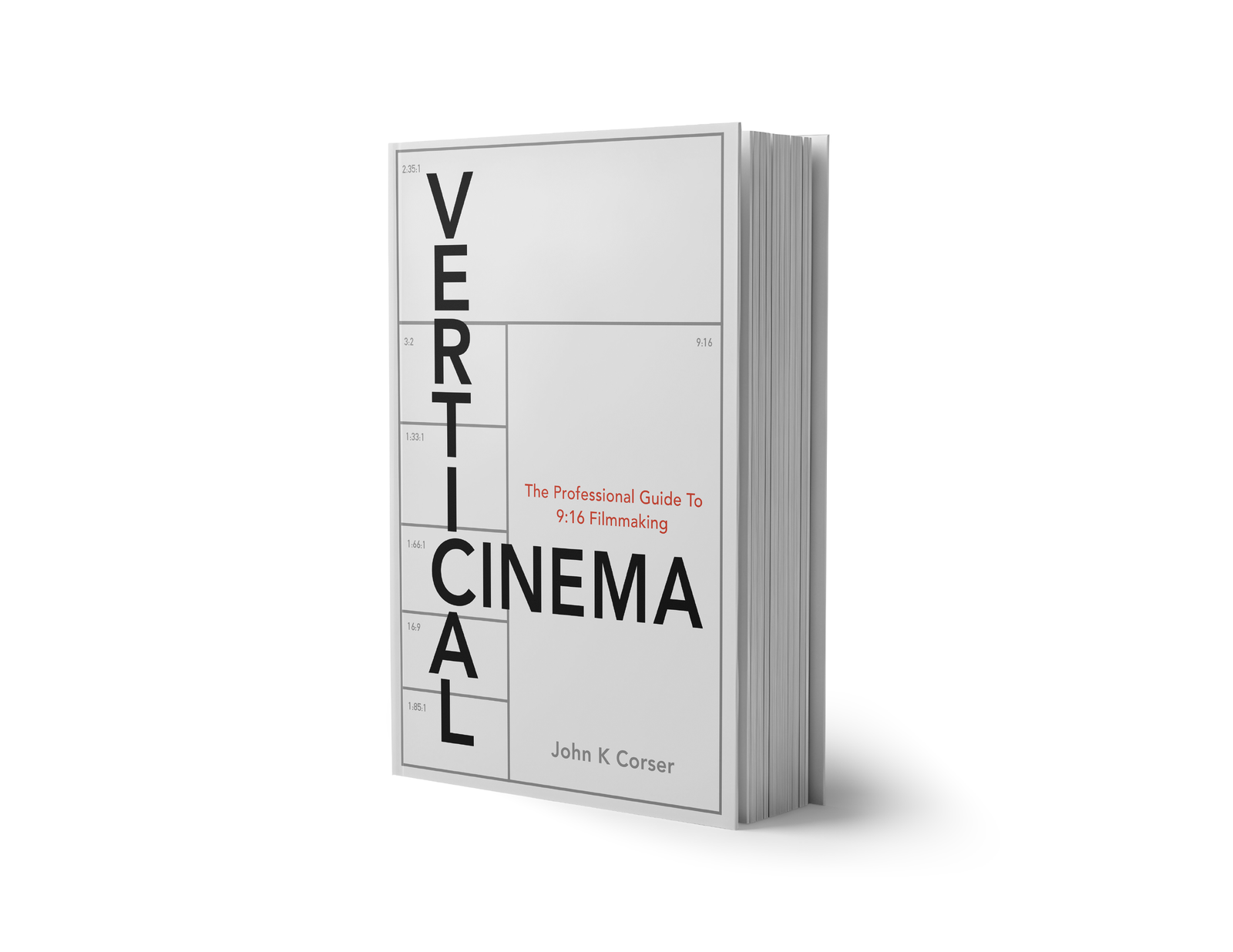
The professional guide to 9:16 filmmaking.
A complete grammar, architecture, and practice for vertical filmmaking, micro-drama production, and directing for phones — the first book to treat the 9:16 frame as its own medium. By Emmy-winning producer John K Corser.
Vertical Cinema: The Professional Guide to 9:16 Filmmaking is the first comprehensive reference for filmmakers, directors, producers, and screenwriters working in vertical video. It covers the full professional workflow of vertical production — from composition and blocking in the 9:16 frame, to micro-drama production for platforms like ReelShort and DramaBox, to the craft of directing actors for a phone-held audience, to the economics of the vertical market.
Most existing writing on vertical video treats it as a format variation — a horizontal workflow rotated ninety degrees. This book rejects that framing. Vertical is not a cropped version of cinema. It is a distinct medium with its own grammar, its own structural architecture, its own production logic, and its own economic model. The book develops the framework that proves this — and then teaches the craft that follows from it.
Written by a thirty-year industry veteran with credits at every budget level from thousand-dollar independents to $200 million studio productions, the book speaks to the filmmaker as a working professional, not a hobbyist. It engages the canonical theorists of film — Eisenstein, Metz, Balázs, Benjamin — and the canonical craft practitioners — Mascelli, Katz, Arijon, Kenworthy — on their own terms, extending their work into the vertical domain.
The Argument
Vertical is a medium, not a format.
That distinction changes everything
that follows.
A format becomes a medium when it crosses four independent criteria simultaneously. No single criterion is sufficient. All four are necessary. Vertical satisfies all four.
Vertical demands its own composition rules, blocking strategies, camera-subject relationships, and an editing rhythm governed by attention rather than continuity. You cannot rotate a horizontal workflow ninety degrees. The attempt produces work that looks broken, because it is.
Distributed through algorithmic feeds on mobile platforms — not theatrical exhibition, broadcast scheduling, or streaming libraries. The algorithm is not a neutral pipe. It is an active editorial force that determines which work survives and which disappears.
Watched on a handheld device six to twenty inches from the face, by a single viewer, typically in a private setting, often without sound. Every one of those conditions shapes what the filmmaker can and cannot do. The intimacy is not optional — it is structural.
Vertical's economic structure — from micro-drama platforms to creator monetization — operates on principles the horizontal industry does not recognize and cannot easily retrofit. The financial logic of a 90-second episode is not the financial logic of a 90-minute film.
Written for working professionals and serious students of the craft — anyone whose livelihood or curiosity depends on doing vertical right.
Practical craft for shooting in 9:16 — shot sizes reimagined for the vertical canvas, blocking strategies for the Intimacy Axis, camera movement that respects the Gravity Line, and a full chapter on the performance direction this frame demands.
The production methodology, budgets, schedules, and workflows of vertical series. Specific guidance for micro-drama production — the ReelShort, DramaBox, and FlexTV economy — including script volume, episode architecture, and market dynamics.
The fractal narrative structure that makes a 90-second segment feel complete while building a 100-episode arc. Segment architecture, hook mechanics, and script templates designed specifically for vertical — not adapted from feature or television formats.
The grammar that separates professional vertical work from amateur. How the frame changes when it stands on end. Why the rules you learned in film school don't hold in 9:16, and what replaces them.
Designed for classroom adoption. Original terminology marked and glossed throughout. Engagement with the canon of film theory — Eisenstein, Metz, Balázs, Benjamin, Cavell — extended into the vertical domain.
A formal theoretical framework — the Medium Threshold, the Fractal Narrative, the Scroll Contract — that gives academic and critical work on vertical cinema the vocabulary and rigor the field has lacked.
From the medium's first principles through its grammar, its architecture, its practice, and its future.
You cannot master a craft without a vocabulary for it. Vertical Cinema introduces the terminology the field has needed — precise enough for set, rigorous enough for scholarship, practical enough to teach in the first week of a film course.
Short answers drawn from the book's arguments. The long answers are in the chapters.
Vertical cinema is filmmaking produced natively in the 9:16 aspect ratio for mobile consumption. The term covers narrative work — micro-drama series, vertical features, short-form drama — as well as commercial and branded content made for vertical-first platforms. The book argues that vertical is a distinct medium, not a cropped format, because it differs from horizontal cinema on four independent axes: production methodology, distribution architecture, consumption context, and economic model.
Micro-dramas are serialized vertical dramas, typically 60 to 90 episodes of 60 to 90 seconds each, produced for platforms like ReelShort, DramaBox, FlexTV, and others. The format originated in China as doupo ju and has become a multi-billion-dollar global market. The book dedicates chapters to micro-drama production — the script volume, segment architecture, hook mechanics, and economic logic that make the format work.
Every variable changes. The rule of thirds doesn't hold. Leading lines pull the eye in the wrong direction. The pan, the most common camera movement in horizontal cinema, is nearly useless in vertical because the narrow frame slides past content too fast to register. Shot sizes that feel intimate in 16:9 can feel claustrophobic in 9:16. Blocking for a two-person scene is structurally different. The book rebuilds the grammar from the ground up, rather than patching horizontal techniques.
Partly. The consumption context — viewers holding a phone — shapes everything, so the book is written for creators making work that will be watched on phones. But production happens across the full tool range, from phone-shot content to fully-crewed 9:16 productions with cinema cameras, lights, and full departmental structure. The book covers the full spectrum. The common thread is that the final delivery is vertical and mobile, regardless of what you shot it on.
Filmmakers, directors, producers, cinematographers, editors, screenwriters, film students, and educators — anyone whose work is or will be vertical. Also: executives, development teams, and investors evaluating vertical projects. The book is written for professionals and serious students, with original terminology defined at first use and a complete glossary.
First edition, 2026. For publication details, press inquiries, course adoption, and speaking engagements, contact the author directly.
Vertical Cinema is represented by Ralph Berge at IAG. For media, course adoption, or speaking inquiries: